
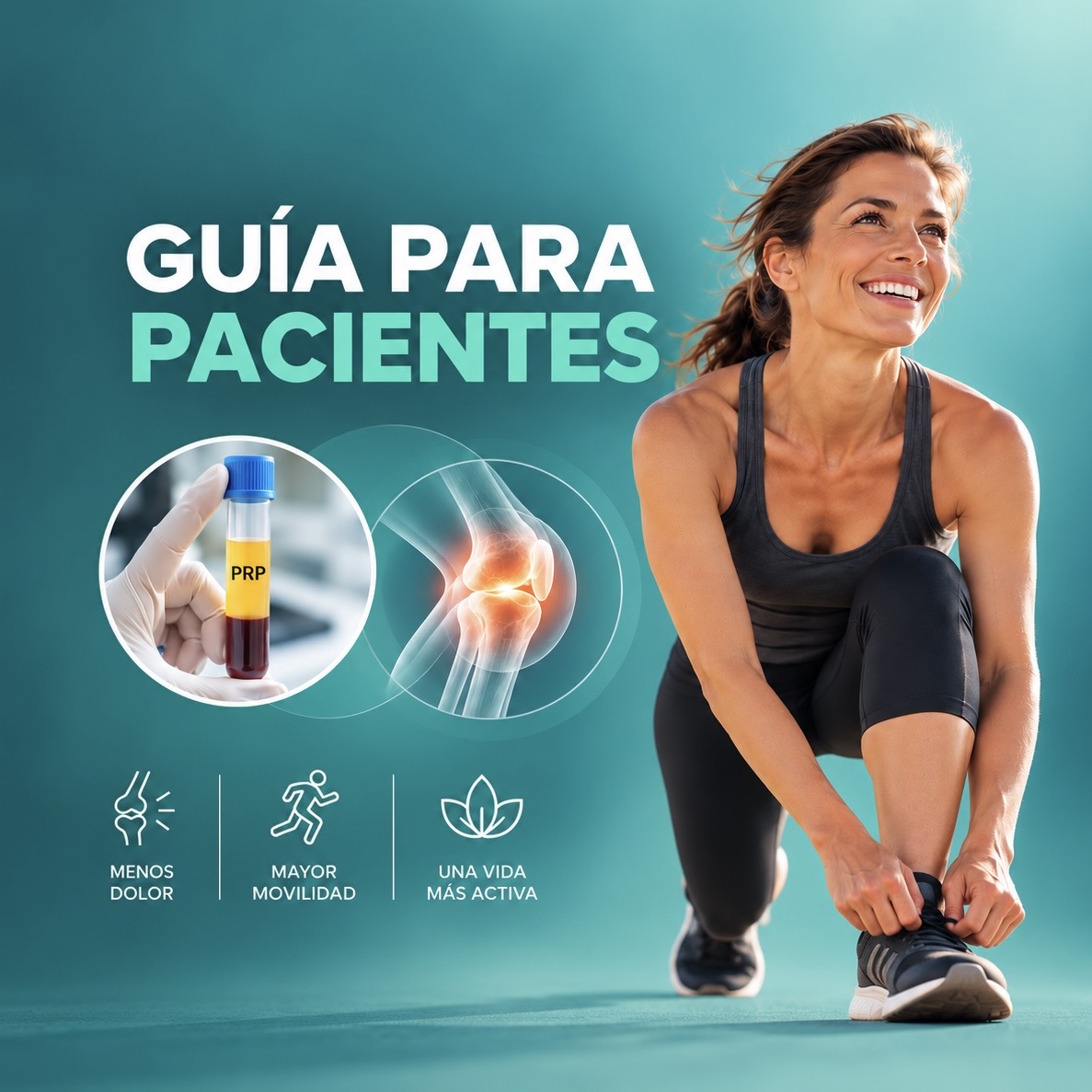



Your treatment with Platelet-Rich Plasma
Everything you need to know before, during and after your ultrasound-guided injection: from preparing the ground to returning to activity.
What is PRP?
Platelet-Rich Plasma is a concentrate obtained from your own blood. By separating and concentrating the platelets, we release growth factors that stimulate the repair of tendons, joints, ligaments and other musculoskeletal tissues. It is an autologous treatment: nothing foreign to your body enters the equation.
Preparing the ground
DAYS BEFOREThe quality of the plasma we obtain depends partly on how you arrive on the day of the blood draw. This preparation isn't a whim: each measure has a physiological reason behind it.
Anti-inflammatories and corticosteroids
Stop NSAIDs (ibuprofen, diclofenac, naproxen, aspirin) at least 7–10 days before. They inhibit platelet activation and may reduce the effectiveness of the treatment.
If you need rescue pain relief, use paracetamol or metamizole (Nolotil), which have less impact on platelet function.
6-hour fast
Do not eat during the 6 hours before your appointment. Eating stimulates the release of pro-inflammatory mediators that reduce the quality of the sample.
You may drink water normally during those 6 hours — stay well hydrated.
Alcohol and tobacco
Avoid alcohol 24–48h before treatment: it alters platelet function and coagulation.
Cut down on smoking if you can — the vasoconstriction it causes hinders the microcirculation needed for healing.
Rest and activity
Avoid intense training the day before your blood draw. A body in relative rest favors a more stable sample.
Get a good night's sleep the night before — rest affects the overall state of the immune and clotting systems.
Anti-inflammatory diet
More than a last-minute protocol, it's a long-term habit: a Mediterranean pattern —oily fish, extra virgin olive oil, vegetables, fruit and nuts— provides anti-inflammatory omega-3s and polyphenols and is associated with more numerous, more active platelets.
Regularly cut down on ultra-processed foods, added sugar and excess saturated fat: dietary patterns with more animal-based and processed foods have been linked to higher inflammatory markers in plasma. This isn't a one-off diet: it's a sustained, healthy eating habit.
Supplements and medicinal herbs
Just like certain medications, some "natural" supplements —garlic, ginger, high-dose turmeric, ginkgo biloba, vitamin E and high-dose omega-3— have an antiplatelet effect. Stop taking them 1–2 weeks before, the same rule that applies before surgery.
On the other hand, maintaining good levels of vitamin D and taking vitamin C together with collagen or gelatin during your rehab may support healing. Always tell us what supplements you take before your blood draw.
Blood draw
5–10 MINOn the day of treatment, our nurse will perform a standard venous blood draw, just like a routine blood test.
BTI collection and handling system
We use specific tubes from the BTI system, a certified, standardized kit designed to obtain growth-factor-rich plasma in an outpatient setting, minimizing variability between draws.
The volume drawn depends on the area being treated and the number of planned injections — usually between one and several tubes.
Processing and quality control
10–30 MINWhile your sample is being processed, you can wait comfortably at the clinic. This is the step where blood becomes the golden concentrate we'll later inject.
Centrifugation
The blood is centrifuged at a controlled speed to separate the layers: red blood cells, platelet-poor plasma and platelet-rich plasma. Excess speed could prematurely activate the platelets, which is why the protocol is carefully calibrated.
Quality control with BioSmartData
Before injecting, we verify the exact platelet concentration with our BioSmartData cell counter. This lets us confirm the sample reaches the right therapeutic dose — not all "PRP" is the same.
The ultrasound-guided injection
5–15 MINThe doctor injects the already processed sample under real-time ultrasound guidance, precisely guiding the needle to the exact target. The sensation varies greatly depending on the tissue treated.
In tendon
It can feel uncomfortable or painful. Several passes are often made (the "peppering" technique) to stimulate the damaged tissue. That discomfort is part of the intended therapeutic mechanism: it's a controlled inflammatory response, not a sign that something is wrong.
In joint / bursa
It's usually painless or with mild pressure. The joint capsule has fewer nociceptive nerve endings than tendon tissue, so tolerance is generally very good.
After treatment
24–72H AND BEYONDPRP works by reactivating an inflammatory repair response — which is why aftercare aims to protect that response, not suppress it.
Local discomfort or swelling
It's normal to feel mild pain, warmth or swelling for 24–72 hours (sometimes up to a week for tendons). It's part of the biological response we're aiming for, not a complication.
Sport and loading
Avoid intense physical activity for 24–48h (up to 72h for tendons). Let the initial inflammatory phase do its work undisturbed before reloading the tissue.
NSAIDs, for up to 7 days after
Do not take anti-inflammatories (ibuprofen, diclofenac, aspirin…) during the following week. They block exactly the inflammatory cascade PRP is meant to activate.
For pain, use paracetamol or Nolotil as needed.
Local cold
If discomfort is intense, you can apply a cloth-wrapped cold pack for brief periods. Avoid systematic, prolonged use: cold can also blunt the inflammatory response we're aiming for.
Progressive rehabilitation
After the first 48–72h, the return to loading should be gradual and guided by your physiotherapist. Controlled mechanical stimulus is what turns PRP's biological signal into repaired, functional tissue — PRP and rehab work together, not separately.
When to contact the clinic
If you develop fever, pain or swelling that keeps increasing beyond 72 hours, marked redness or discharge at the injection site, contact us.
Scientific basis of this guide
- Kao DS, Zhang SW, Vap AR. Systematic review on the effect of common drugs on platelet count and function: which medications to stop before a PRP injection. Orthopaedic Journal of Sports Medicine, 2022.
- Review on PRP use in patients taking NSAIDs: recommended withdrawal times by drug (ibuprofen, diclofenac, naproxen, indomethacin). PMC, 2024.
- Magruder M, Rodeo SA. Is antiplatelet therapy contraindicated after PRP? A narrative review. Orthopaedic Journal of Sports Medicine, 2021.
- Perspectives on optimizing PRP treatment for tendinopathies: pre-procedure fasting, centrifugation speed and NSAID/corticosteroid withdrawal window. Muscles, Ligaments and Tendons Journal (PMC).
- Townsend C, et al. Post-procedure protocols following PRP injections for tendinopathy: a systematic review. PM&R — Journal of Injury, Function and Rehabilitation, 2020.
- Gremeaux V, et al. Rehabilitation and return to activity after PRP injections for chronic tendinopathies: an international expert consensus. PM&R, 2026.
- Levine B, et al. Post-injection protocols for PRP in knee osteoarthritis: a systematic review. PM&R, 2024.
- Montagnino J, Kaufman MW, Shetty M, Centeno C, Fredericson M. Optimizing orthobiologic therapies through exercise, diet and supplements: a narrative review. PM&R, 2025.
- Cummings KC 3rd, et al. Perioperative management of patients using dietary supplements: SPAQI consensus statement on 83 supplements, including their antiplatelet effect. Mayo Clinic Proceedings, 2021.
- Shaw G, Lee-Barthel A, Ross ML, Wang B, Baar K. Vitamin-C-enriched gelatin supplementation before intermittent physical activity increases collagen synthesis. American Journal of Clinical Nutrition, 2017.
This guide is for informational purposes and complements — never replaces — your doctor's personalized guidance. If you have any questions about your specific case, discuss them with the Fisioplanet team before treatment.
Musculoskeletal Ultrasound · Palma